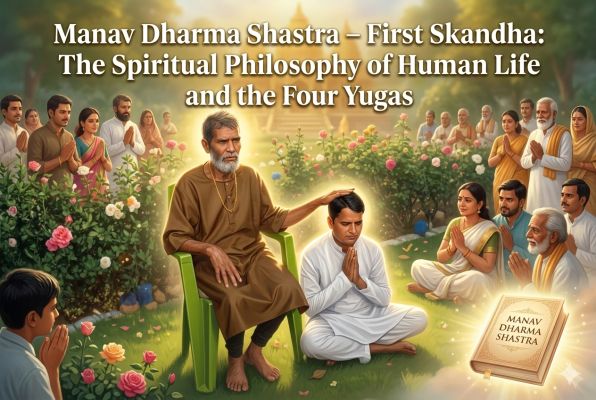
Manav Dharma Shastra – First Skandha: The Spiritual Philosophy of Human Life and the Four Yugas
Posted By: Awadhoot Devidas Seva Sansthan
07 Mar 2026
Manav Dharma Shastra – First Skandha: The Spiritual Philosophy of Human Life and the Four Yugas
The First Skandha of Manav Dharma Shastra explains the spiritual mysteries of human life, the structure of creation, the three qualities (gunas), and the deeper meaning of the four yugas in simple language. This scripture guides humanity toward truth, self-realization, and a positive way of life.
Introduction
In the Indian spiritual tradition, many sacred texts have been composed to guide humanity toward the right path in life. One such important scripture is Manav Dharma Shastra, whose first part, the First Skandha, attempts to explain the fundamental principles of human life.
This scripture was composed by Gurudev Awadhoot Lakshminarayan Ji (Lakshminarayan Meena, IPS, W.B. cadre) under the blessings and spiritual inspiration of Satguru Awadhoot Devidas Maharaj Ji. The deeper mysteries of life are presented here in very simple language so that even ordinary people can understand them and apply them in their lives.
The purpose of the First Skandha is not merely to provide religious knowledge but to inspire human beings toward self-reflection, morality, and spiritual awareness.
The Nature of Creation and the Supreme Divine
The First Skandha begins with the description of the glory of the Supreme Divine (Parmatma). It explains that the Divine is the source of the entire creation. He is the creator, sustainer, and controller of the universe.
The Divine is omnipresent, omniscient, and eternal. He is not limited to any single form or place but exists throughout the entire cosmos. When a person realizes this truth, humility and spiritual awakening arise within them.
The true purpose of human life is to recognize the divine consciousness that exists within oneself.
The Three Gunas and Human Life
According to Manav Dharma Shastra, the universe and human life are governed by three fundamental qualities:
1. Sattva (Purity)
Sattva represents purity, wisdom, compassion, and truth.
A person dominated by Sattva is calm, kind, and righteous.
2. Rajas (Activity)
Rajas is associated with action, desire, and ambition.
It motivates humans to perform work and achieve goals, but when excessive it can lead to greed and ego.
3. Tamas (Ignorance)
Tamas represents ignorance, laziness, and negativity.
When influenced by Tamas, a person develops confusion, anger, violence, and selfishness.
The balance of these three qualities forms the foundation of true spiritual development.
The Spiritual Meaning of the Four Yugas
In the First Skandha, the four Yugas are not described only as historical periods but also as states of human consciousness.
Satya Yuga – The Age of Truth and Dharma
Satya Yuga represents the highest state of human consciousness.
Truth, compassion, and righteousness prevail. People live in harmony and society remains peaceful and balanced.
Treta Yuga – The Age of Order and Balance
In Treta Yuga, morality and dharma still remain strong, but human desires and ambitions begin to increase. Governance and social structure become more important.
Dwapar Yuga – The Age of Conflict and Competition
During Dwapar Yuga, Rajasic tendencies become stronger.
People seek wealth, status, and power, which leads to competition and conflicts in society.
Kali Yuga – The Age of Ignorance and Illusion
Kali Yuga is dominated by Tamasic qualities.
Human beings become more attached to material pleasures and forget spiritual values. As a result, selfishness, inequality, and conflict increase in society.
Challenges of Modern Society
The First Skandha also explains that modern society faces many problems such as:
- Increasing greed and selfishness
- Social inequality
- Religious conflicts
- Family tensions
- Mental unrest and dissatisfaction
The main cause of these problems is that human beings have forgotten their true nature.
Self-Realization as the True Solution
According to the scripture, the solution to these problems is not found in the external world but within the human being.
When a person practices self-reflection, abandons ego and negative thoughts, and walks on the path of truth, peace and balance emerge in life.
Through self-realization, one understands that the true purpose of life is not merely material enjoyment but recognizing the divine presence within oneself.
Conclusion
The First Skandha of Manav Dharma Shastra is not merely a religious text but a spiritual guide for human life. It teaches that liberation from suffering, confusion, and conflict can be achieved through the path of self-knowledge, truth, and compassion.
If human beings cultivate Sattva, follow truth and righteousness, and practice self-reflection, they can make their lives meaningful and peaceful.
The message of the First Skandha is clear:
True peace and happiness do not exist in the external world but within our own inner being.
Manav Dharma Shastra, First Skandha, Gurudev Awadhoot Lakshminarayan Meena IPS, Satguru Awadhoot Devidas Maharaj, purpose of human life, knowledge of four yugas, Satya Yuga Treta Yuga Dwapar Yuga Kali Yuga, spiritual life guidance